



Promoting an agenda as serving the people that primarilt benefit investors and developers is a historical tradition in Maine backed up by years of narrative craftsmanship

The other day I signed up for a networking meeting on Allignable and learned about hour long sessions of one on one 7 minute meetings with other profesionals. Today throigh such a session I learned of a foundation called Businesses with a Purpose, a name addressing the popular misconception that a free enterprise is “only in it for the money”. Its a hopeful discovery but too soon to know what the foundation is practically about,.
I signed up for Allignable years ago but because there is so much to pay attention to, I didn’t do anything with it and so as an outcome of the first engagement, I was advised to add product images to my Allignable profile.
In the next speed meeting session I had published some photos and was advised that they would be very good for Tik Tok, so I am working on making more videos and to use the ones I have more effectively.
I imagine a common video making space in the Workers in Residence Priority Zone, The way to go about manifesing such a zone would be to form a non-profut organiization dedicated to establishing working in residence and compatible alternative :priority zones: across the state, which cannot happen without acquiriing land for that purpose. If such an umbrella organization exists, groups could apply for funding to purchase the land whenever an opportunity arises. or before it arises,
I am imagining the zone on the Boothbay Peninsula, but my interactions with leadership has not only been unhelpfu, but as rude as interactions often are on social media. For example Wendy Wolf was the head of the Joint Economic Development Council of Boothbay and Boothbay Harbor when I approached the council about forming a Museum of Americant Designer Craftsmen, for which I was then fiscally sponsored to develop by Fractured Atlas in NYC. Ms Wolf told me to “Go get help from by own peer group”.
Did Ms Wolf mean other small entreprenuers out side of the hospitality industry? Now I see she was giving me sound afvice. My government is not here to help me or other small entreprenuers. The council was taking money out of Boothbay local property taxpayers pockets, such as I was, to fund an advertising campaign for downtown Bootbay Harbor small businesses. This was Ms Wolf’s idea of economic development, which is nothing short of local public wealth redistribution, mirroring what the State has been practicing since 1976, but at least there is a connecton to economic development, unlike several large projects that have been funded with public money and spearheaded by local oligarch Paul Coulombe.
The JECD had just spent even more of the peoples money to purchase a plan for the region by a New York consulting firm that reccomended museums for the Peninsula but the JECD ignored that entirerly. It appears that the only reason for spending $7900,00 of local taxpayers money on hiring outside the Peninsula to create an economic development plan was for appearances sake only as the Town Selectmen had told the JECD that it needed a plan. so the HECD purchased one rather than engaging with the inhabitants of the community outside of those they qualify as their own peer groyp.
Paul Coloumbe also described the Peninsula as not having enough amenities. A Museum is an amenity. I envision a Museum of American Makers as a focal point of the Business in Residence Priority Zone, but Wendy Wolf was not interested in a discussion of ideas, She was asserting her position on a totem pole, as was the case with the two gents my father approached about a B2B relationship back in 1956., but after recognizing the talent and value of my Dad’s proposal descended into power politics and ended up referring to my Dad as their employee with no right to be presenting ideas.
History and Contemporary World of Hand Made Making A Twist of Fate Unearths a I950s Time Capsule!
·
November 5, 2023

That is the psyche of a centrally managed society. No one paid much mind to what was in the 79000,00. community development plan. Wendy Wolf bought advertising and Paul Coulombe tried to tear down the midcentury high school and replace it with a structure most noticably marked by a tall corporate Tower of Power, as if corporatism makes sense for a rural oeninsula with an endangered water supply.
Ms Wolf was expressing the unspoken truth, that, outside of the summer tourist industry, the local government of the Boothbay Peninsula does not support its small entreprenuers, and will not entertain any ideas. The Boothbay Town selectmen have chased many small businesses off this peninsula, and yet when the Boothbay Regional Development Corporation approached them with money in hand gifted by the favorite local oligarch, the selectmen’s only question was “What can we do to help?
I like to resource what I report in this newsletter so I searched Substack for posts I have published about the BRCD where i linked to the Town meeting minutes. I haven’t found that yet but In the process I came across the following, from 2023, which I had forgotten all about:
Quote:
I decided to download the Articles of Incorporation for The Boothbay Regional Development Corporation on the Maine Secretary of State website.
But I did not receive the download, instead, I see this on the Maine.gov screen:
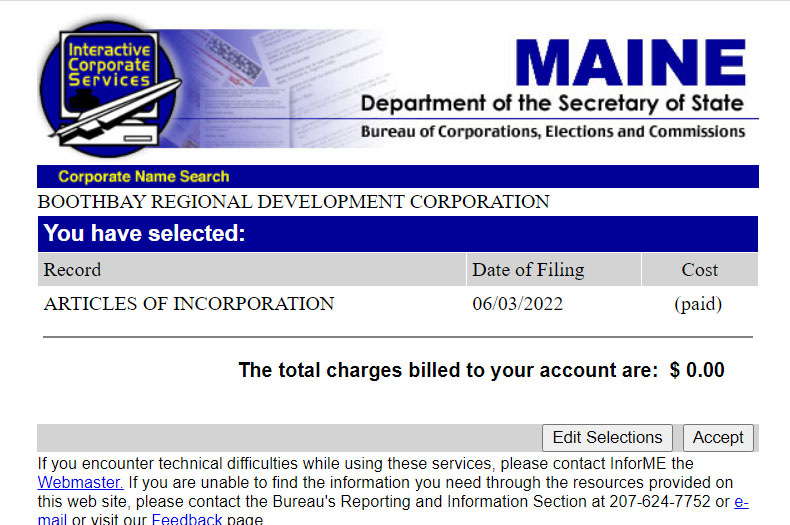
This has never happened before when ordering a file download from Maine.gov.
But while looking for something else, I found the articles of incorporation in my own files.
Back in November, I contacted the Secretary of State’s office to ask for help in finding the Boothbay Region Development Corporation. The agency could not find a corporation by that name but it found the Boothbay Regional Development Corporation.
I paid three dollars to download the articles of incorporation but the file downloaded 98% and then failed so I contacted the office again and received the articles by email.
At first glance, the articles did not look significant. The only name is the name of the clerk. There can be three to seven directors and no members. The corporation is a public benefit corporation according to Attachment A
The agent wrote that when the articles of incorporation were filed, they attached information indicating that they were being formed for 505C 3 purposes.
The BRDC is strategically timing when to apply for a 501(c)(3), doing things that are prohibited by 501(c)(3) status before taking that step, while indicating that they will take it asa means of acquiring those advantages in advance. A 501(c)(3) is not supposed to influence legislation so Erin Cooperrider, the VP, and spokesperson for BRDC wrote the framework for LD 2003, before BRDC was incorporated. LD 2003 promotes building concentrated housing zones across the entire state of Maine, transforming and conforming the character of many diverse communities in one strike.
A month after the enactment of LD 2003 Cooperrider is heading up a non-profit housing development corporation on the Boothbay Peninsula,Quoted from Smoke and Mirrors and General Impressions or Eyes Wide Open in Taking Back Ownership Equality! Jan 02, 2023 by Mackenzie Andersen
- LD 2003: was enacted on April 25, 2022, as HP1489 “Act To Implement the Recommendations of the Commission To Increase Housing Opportunities in Maine by Studying Zoning and Land Use Restrictions” The name of the act clearly states that the Commissioners, private citizens from the developer and realator industries, influenced the legislation. Appendix Q identifies Erin Cooperrider as one of the three commissioners who wrote the framework for LD 2003.
I contacted the Maine Secretary of State’s Office and asked if it could provide information about the unlisted corporation, The Boothbay Region Development Corporation.
This is the answer I received fromthe Maine Secretaru of State’s office:
The closest entity I found on our records is Boothbay Regional Development Corporation. They filed articles of incorporation with the Maine Secretary of State as a nonprofit corporation June 3, 2022. The incorporator and the registered agent listed is Drew Anderson of 75 Pearl Street, Portland, ME, 04101. When the articles of incorporation were filed, they did attach information indicating that they were being formed for 501-c-3 purposes and following that criteria. The charter number for this entity is 20220522ND. 2003–
In Sept 2022 a Boothbat Register article titled,Selectmen get housing development presentation Erin Cooperrider states:
“The goal is to create a range of housing choice both for sale and for rent and affordable to our workforce at a range of socioeconomic levels,” said Cooperrider. “The phases would be home ownership first, rental housing second and additional home ownership in a series of phases depending on how the site builds out, market conditions and financing sources.
….Since the buildout will take about a decade, Cooperrider said there will be hurdles in development, namely density; the project is designed for 162 units which exceeds the local maximum by 47 units. However, recent legislation, LD 2003, has opened up potential for changes in housing limits and metrics, Coopperrider said. “This plan shows 3.5% density bonus for affordable housing, so three and a half times what’s allowed currently (which is) two and a half times.”
Modestly, Cooperrider did not give herself credit for the significant role she played in authoring LD 2003.
The article goes on to report that “The first of several phases of housing construction on the Butler Road site will consist of 24 for-sale condominiums targeted at households making less than 80% of AMI ($64,400 for a family of four).”
As Butler Road utility extension nears completion on 07/01/2024 the target changes to “both for-rent and for-sale options, targeted to households making between 80% and 120% of the Area Median Income.”
The Town awarded the Boothbay Regional Development Corporation, 50,000.00 of the town’s American Rescue Plan Act (ARPA) funds, in September 2022. Perhaps that is why when The Boothbay Regional Development Corporation (BRDC) secured its 501(c)(3) status in June 2023, with the designation being retroactive to June 2022, less than a week after LD 2003 was enacted as HP 1489, so technically,Erin Cooperrider, the co-author of the law was not involved in the non-profit corporation at the time she was active in writing the legislation, The official ruling date for the BRDC;s tax-exempt status is February 1, 2023, but making it retroactive to June 2022 makes it a 501(c)(3) when the Selectmen of Boothbay granted the ARPA funding. Source: Boothbay Regional Development Corporation secures 501(c)(3) status; secures ARPA funding
The town of Boothbay is providing $1,500,000 in TIF funding towards this project. The non-profit Boothbay Regional Development Corporation (BRDC) also contributed $250,000 in ARPA grant funding from Lincoln County, and $50,000 in ARPA grant funding from the town of Boothbay, source
The BRDC campaigned for the Town to use TIF funding to finance connecting the water utiliies to the development. However according to Google AI TIF (Tax Increment Financing) money is used to pay for public and private development projects. The TIF funding mechanism helps finance projects intended to spur economic development, create jobs, and revitalize areas, and the additional property taxes generated by the project are used to repay the TIF bonds or loans.
The Maine statutes link property tax exemption to 501(c)(3) status:
(a) “Nonprofit housing corporation” means a nonprofit corporation organized in the State that is exempt from tax under Section 501(c)(3) of the Code and has among its corporate purposes the provision of services to people of low income or the construction, rehabilitation, ownership or operation of housing source
A 501(c)(3) organization is property tax exempt and so the plan must be to charge property taxes to the individual buyers of the property but in 279 days there has not been a sale, despite the act, co-authored by the corporation’s VP, being enacted as an emergency and Boothbay being selected as a first location fof overcrowded housing zone justified as address the emergency.
The Town, County and State granted the BRDC affordable housing funding apparently without asking about the terms being offered to would-be homeoners as stated on the BRDC website. Those terms are highly unattractive for the home buyer, quite the opposite of what “affordable housing” is understood to mean. Anyone who puts themselves in the home buyers shoes can spot this.. Now, after all is said and done, the $3.4 million development sits empty. It is not generating economic development nor property tax revenue for the Town. It was indded a risk, not a sure-thing as portrayed by the Boothbay Town selectmen.
That may not be quite true, As reported in addition to water serving the Butler Road property, sewer service will now be available to nearly thirty additional property owners on Country Club and Butler roads. source so it could pay off for developers in of high end properties and short term rentals situated around the Countrty Club.or if there were enough of a people’s initiative, for independent developers for housing for the much needed 60% or below AMI.
Much of the funding for the development came from “AHOP” the Affordable Homeownership Program that provides subsidies to developers to create “single-family homes for middle-income households” with Subsidy Type: Zero percent forgivable loans and is run by MaineHousing, Note the change in language from”low-income” to “middle income”- translation- from 80% or below AMI to 80%-120% AMI, the target of BRDC. Why does the program targeting developers target :midle income” instead of “low-income”? Do market rates apply for the middle income market?
The BRDC impressed the Town Selectmen but that does not translate to convincing the public to buy in on a bad deal. The people reject it. The terms are that the inhabitants pay 41% of their income for housing expenses which HUD qualifies as cost-burdened. Since the financing terms are stated as a percentage rather than a fixed amount, if the inhabitant’s income increases, so does their rent or mortgage payments and if they sell the property the BRDC claims 75% of the increase in value, so besides being priced at market rates rather than affordable rates, the deal is an economic trap. That’s not what affordable housing was intended to be.
Before the school project Paul Coulombe convinced the sellect board to use TIF financing for his plans to rennovate the Center of Boothbay, surprisingly making it look like an extention of the country club, carefully pruning trees on the hillside to reveal the country club buildings sitting like castles on a mountain in a feudalistic landscape, Repetitive beds of identical flowers descend into the center of Town repeating the theme of repetitiveness and indistinquishable identical units of the housing barracks in overcrowded zones, also partially financed by Paul Coulombe, and located on another side of the country club, the center of everything in Mr Coulombe’s community design.
Mr Coulombe had been instrumental in establishing the TIF Zone in 2013. It was first voted down by the public but the Town selectmen decided to run a reconsideration vote about a month after it was voted down, as reported in the BoothbayRegister.
Now the town aims to put together a scaled down version of the TIF by December 11. The selectmen said they want to use the next few months to help voters understand the benefits of what a simple TIF district could bring to the region.
“The TIF is purely beneficial to this town, whereas the bond came with some risks,” Selectman Dale Harmon said. “The TIF doesn’t come with any risks. It just comes with a funding mechanism to do something with down the road, and maybe give an incentive for businesses to be attracted to the district in which we drew the lines around.”
The original proposed TIF district was drawn around 272 acres that encompassed the Industrial Park, the Route 27 corridor, the Boothbay Common and the Boothbay Harbor Country Club.
When owner Paul Coulombe said he planned to spend about $17 million more dollars on the country club, the selectmen wanted to capture the additional property tax revenue from the new development.
Additionally, the selectmen asked voters permission to take out a $2.5 million bond to improve traffic safety through the Boothbay Common. Although the selectmen said they would not take out the bond if they could not secure matching state funds, controversy erupted over a traffic roundabout introduced as part of a concept design called the Boothbay Village Improvement plan.
……….If the selectmen delay the vote until the annual town meeting on May 5, the town could lose out on an estimated 40 percent of the overall tax shelter. Each April, the town’s value is reassessed; this coming April, that reassessment will add the value of all of Coulombe’s improvements to date
The idea behind TIFS are that the funded project will stimulate economic development, raising property values which will fund the debt created by the project. . Where are the properties that will pay property taxes in the round about? Did they install bird houses? Do they expect fowl to pay up? Or do they propose that the transformation of the Town Center raises real estate prices generating tax revenue to pay for the round about, which was sold to the public as resolvinga safety issue, (read more here). Supposedly the traffic at the four way stop was so dangerous that ir gad to be combined with all the other trafficariund a round about, strategically situated in the middle of the road at an entrance to the Country Club. Apparently the Town Selectment approved the expenditure on the basis of their trust and confidence in the knowledge and experience and infrastructure design talent of Paul Coulombe, who knows whats best for the community and can throw money around. Wendy Wolf also promoted the round about,so identifying her peer group.
While it may be true that Paul Coulomb’s investments raise property tax revenue generally, it is more convincing that short term rentals do so, the round about has no identifiable impact on property taxes. It just rebrands the community as revolving around the Country Club, which Paul Coulombe says is not a profit making venture but something he is doing to benefit economic development for the Town.
Paul Coulombe’s brand of economic development is expanding the wealth divide consistent with that of the state.
The Case for the Alternative Vision of Economic Development
A Business in Residence Priority Zone, as I have been conceptualizing in this newsletter, is about economic development in which the role of the state is to balance distribution of wealth to foster a large middle class, making upward mobility more accessible to those at the bottom and is environmentally sustainable.
Location, Location, Location
Next Mr Coulombe set his eyes on the high school, situated on a hill on the road entering Boothbay Harbor. He contributed to and organized anonymous investors group who financed an architectural design of a new school to replace the current high school that spreads long and wide across the terrain, built in the era of the great American middle class.
The local school board did not question the legality of accepting such a gift to advance a referrendum agenda, They dug their heels in to making it happen and are still trying to advance the plan today in defiance of what the public wants.
The most recent ploy is include in the school charter that a district meeting vote can replace a municipal referrendum for capital bonds over $250,000. According to Alternative Organizational Structure 98 Superintendent Robert Kahler, the process is the same as municipalities follow and would fulfill resident approval requirements without the cost of a referendum, which could be around $10,000.
That would allow the board to bypass a municipal refrrendim on any amoubt over $250,000 including the demolish and replace plan that was shot down in a municipal referendim. While it is illegal to politic around the voting location of a municipal referendum, at a school district the board rund the show and politics for their agenda right up to the vote.
My idea of Land to Individuals is radical only in current context. It doesn’t need government to make it happen but it does need a private non-profit organizayion. I have spotted land for sale, which is a very wonderful location, The price of the plots are reasonable at est 299.00 per month per acre. It would be perfect for Land to Individuals but it could also be bought by developers of short term rentals.