


Is Fiscal Sponsorship a Way Back to Fairer Distribution?

Stop Trying to Make Sense of the World- Just Deal With it As it Really Is
First published in 2019 rewritten in oct 2025
In 2019 I spent three weeks as a volunteer labor writing a review of a paper about a nineteenth-century philosopher known for advocating the abolition of private property.
I was reviewing a paper for publication consideration in a global peer-to-peer academic publishing organization where the primary shareholders are deeply invested in global publishing, financial assets, and real estate across the Western world.
I was approached by the organization in the manner of a non-profit organization, asking for a donation, not of money, but of my services.
I have a proclivity to place other purposes before money, and so providing volunteer services to a wealthy for-profit organization is worth it for what it delivers in karmic justice. It gives me a voice in deciding which papers are to be published. It is particularly meaningful when the subject is a nineteenth-century philosopher deeply entrenched in an academic culture that produces graduates who become the deciders about who gets the portions of the global pudding of redistributed wealth.
I am undecided about whether the deciders of our fates are merely products of indoctrination or are the self-aware manipulators of culturally embedded indoctrination, using it to the benefit of their own self-interest. Either way, it is to the benefit of all mankind to pierce the balloons of indoctrination with the pin of perception. I am but one among many of the Invisibles, and this is my story.

I am the outsider that the nineteenth-century philosopher wrote about. By the philosopher’s own definition, the outsider is not recognized. Thus, the nineteenth-century philosopher did not recognize me, so blinded was he to the value of work, by the value of ownership, that he pushed my class of small entrepreneurs who are at once workers and owners, to the outside of what was to become the global world order, where the class of small entrepreneurs remains in today’s world, concealed in the ground like a seed After Trump gets done with us, there will be nothing left but the ground waiting for the new seeds to sprout. The world cannot be reconstructed the way it was, so let it be that a chance for a change for a better world that recognizes alternate systems of value emerge from the ashes, fertilizing seeds hidden beneath the ground.

While I was doing the review, I had to think about Marx.
Marx is like a cake mixed with ingredients of self-contradictions, topped with a very thick frosting of diatribes directed at undifferentiated masses participating in one social order or another, the nineteenth-century version of the internet meme. I have no idea what the percentage of frosting is on the cake, as reading Marx makes me feel like I, or some other group, is being beaten upon, and then I stop reading.
However, given Marx’s enduring popularity, there must be a nugget of truth worthy of recognition. In my own thinking, I aim to separate the truth at the core from the misleading diatribes. In a nutshell, I agree with Marx on one point, that money is often made into the exclusive measure of value and which nurtures inauthenticity in both the individual and society. I do not agree that there is one monetary system in which all participants are exclusively motivated by self-interest and care only about money, and another monetary system operating exclusively from a pure, unselfish interest for the betterment of mankind and our environment. Nice branding that doesn’t fly.
It needs to be recognized that in the contemporary order, that even if the cultural economic distinctions of Marxian ideology were true, today the oppositional structures (for-profit, non-profit, public-private) are so entwined in a symbiotic relationship that there is little difference between them as they are inseparably united in the embrace of a wealth-redistribution economy that trades in debt-free capital and fiat currency.
One day, in 2019, as my thoughts were wrapped up in the philosophy of Marxism, I noticed a little gray arrow on my Facebook messages pointing right, to which I had never paid much attention. There I found a message from previous September from the Communications Director of the Maine Development Foundation, saying she had read one of my blog posts, which she did not name, but she said they would like to meet with me, suggesting sometime in October “to ensure we understand and address your concerns/questions”. The message impressed me as the intent to have oversight on what I publish. I did not feel it was an interest in my economic development vision. If MDF were interested in addressing my concerns, I think they would have chosen another contact method.
I wrote back, saying I couldn’t think of any questions about the Maine Development Foundation at this time, and wrote about my own economic development vision, neither anticipating nor receiving a response from the Maine Development Foundation.
The Communications Director at a large organization only wears one hat. As Communications Director of Andersen Design, It is only one of so many hats I wear that I don’t bother with titles. Such is the culture of a small business.

The Maine Development Foundation was chartered by the Maine Legislature when it created the command economy in 1976. At that time, Maine had the fastest-growing small enterprise economy in the nation, composed of businesses employing up to 100 people. Andersen Design was one of those businesses.

The Psychology of the State
In 1976, Maine’s Governor Longley created a task force composed exclusively of the heads of Maine’s largest and wealthiest corporations, excluding the voices of the small business community, which was developing strongly enough at the time to have caught the Governor’s attention and which could be used as justification for over writing Maine’s constitutional form of government, replacing it with a centrally managed government. Small businesses became the poster child of the cause, from which they are excluded from participation to this day.
The leaders of the largest corporations declared that a centrally managed economy must be created to come to the rescue of small businesses and help them to find capital. The large businesses asserted that equity capital would be much more advantageous to the small businesses of Maine than debt capital. No small businesses were invited to participate in the conversation, ensuring that such assertions would find no refutation.
A similar view was asserted in a 1956 series of letters between two business partners. Someone close to the partners gave the letters to my Dad, and I came across them many years later.
My father had approached the partners in 1956 in the spirit of a business-to-business collaboration.
The details of the terms that my father presented for his design and production services were not found in the letters, but the story that comes through is that my Dad approached the partners with a design project of limited parameters in which Dad would design ceramic ware to complement the company’s food products, which they sold as a gift basket.
One partner tells the other that Dad had agreed to have their company name on the designs, and the partner thinks the designs will help their company to get a larger spread in House Beautiful. I believe that Dad would have agreed to branding his designs with the other company’s name only as a limited project, similar to the way Eva Zeisel designed limited lines for dinnerware companies such as Hallcraft, with Eva Zeisel given credit as the designer. Dad learned slip casting from Eva as an Industrial Design student at Pratt Institute, and would also have received an education in the common practices in paying designers. The partner thought that limiting Dad’s design activities for their corporation was “ridiculous.”
Nowhere and at no time did we discuss the possibility of limiting your design and management to a specific list of items. In effect, this says you are to be paid for your designs already completed on a continuing basis with no responsibility for improvements or new developments – which is ridiculous
Did he make a mistake and write “ridiculous”, intending to say “residuals”?
re·sid·u·al
a royalty paid to a performer, writer, etc., for a repeat of a play, television show, etc. Dictionary.com
Were the two partners expecting that they would own everything that Dad designed for life? That is the essence of equity capital versus debt capital.
The reason they had not discussed the matter previously appears to be that there has been no discussion previous to Dad’s presentation of how Dad would be compensated for his contribution. The attitude of the partners is that only they can introduce a subject of discussion when, in fact, they are discussing an innovative idea presented to them by my Dad. The attitude is that the partners will dictate everything, shown by their delusional reference to Dad as their employee in the letters and their formulation of the agreement being solely related to their corporation, when in fact Dad is speaking of issues relating to his own corporation and expressing “his thinking” on how he will be paid for services delivered to their corporation.
The concept that any reasonably intelligent person will sign over corporate business decisions to the “sole judgment” of any employee is unthinkable. We have constantly stressed the importance of equal voice. quote from the partner’s letter
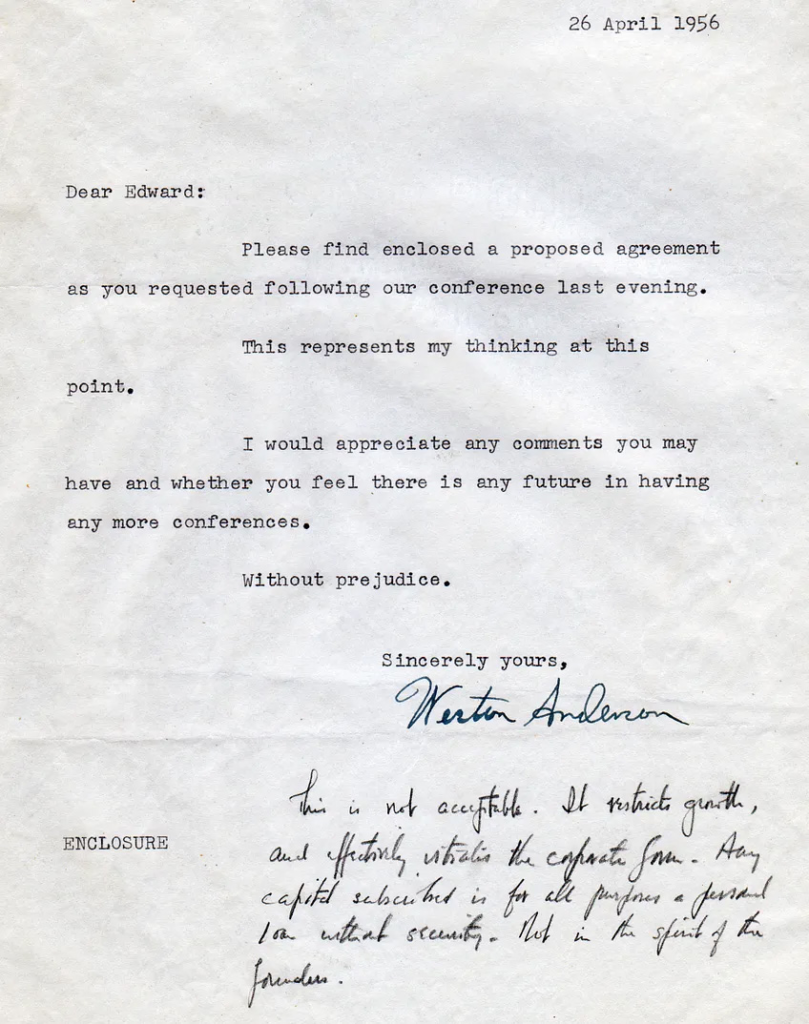
The letter above identifies that the contention is about Dad’s preference for debt capital versus the partners’ preference for equity capital. The letters speak for why debt capital is preferable to equity capital for the small business person, as the partners show themselves to be psychologically incapable of a business-to-business relationship, as they dwell in an illusory reality in which Dad is their employee.
A major challenge to my concept of a production as a network of independently owned studios is on the psychological level. Most people are psychologically conditioned by the hierarchical structure reinforced by a centrally managed economy, which encourages roles of dominance and subjugation rather than collaboration.
AI Overview: A heterarchical system for collaboration is an organizational structure where relationships between elements are unranked and power is distributed across multiple interdependent groups. Unlike a strict top-down hierarchy, a heterarchy allows for more flexible, lateral connections and distributed decision-making, which can foster greater innovation and adaptation.
When the state develops its dictates to the small enterprise community about such things as “a quality job,” it considers only what it, the state, deals with- which is the amount of revenue the state will collect from the personal income taxes generated by the “quality jobs”. The state does not have to deal with the psychological and work-related character of a job, so the state deems such a measure of quality to be inconsequential-declaring a quality job is only about the money! That is why the state needs to exclude those who do the jobs from the conversation.
However, the series of letters, mainly between the two partners, makes a pointed testimony about why debt capital is preferable to equity capital for psychological considerations, which matters to workers because they have to deal with psychological environments. The State and the Investors just have to deal with money, so they decide equity capital is better than debt capital, but today the small enterprise community is mainly distributed debt capital by the state, as that works out more profitably for investors.
The report concocted by Governor Longley’s board recommended that the Maine Capital Corporation be chartered to help small businesses with financing, but the Maine Capital Corporation mainly benefited investors by providing them with lavish refundable tax credits and did very little for small businesses, setting the model for all that followed. I have documented that story in I am a Baby Boomer, and this is the story of how my generation let the great wealth divide happen;

The Governor’s Task Force report recommended that two complementary corporations be chartered by the Legislature: The Maine Capital Corporation and the Maine Development Foundation, which is not a foundation, in the traditional meaning of the word. If I am wrong on that, I welcome being corrected, but to my knowledge, the Maine Development Foundation does not fund charitable activities.
Better is always better.
If one were to take the rationalization about the superiority of equity capital to debt capital as a real and valid motivation for establishing a centrally managed economy, including the chartering of the Maine Development Corporation, and if one were to accept that the motivation for instituting the command economy of Maine was the selfless desire of the founders to serve the interests of the pre-existing small enterprise economy, and then extrapolate that into today’s world, the argument would be that debt-free capital, sourced in foundations and other non-profit funding resources, is better than debt capital or equity capital for the small business sector.
Debt-free capital sourced in non-profit funding allows the recipient to retain ownership, beating out equity capital.
However, if one is to look instead at how the centralized economy has worked in practice, one might conclude that the overlords of central management understand why debt-free capital is better and that, therefore, its benefits should be reserved for the investment community to be loaned to the small business class for a profit scaled to fit the non-profit purpose of the parent organization.

Social-Economic Justice
As this story shall demonstrate, every other sector has access to debt-free capital; why not the small business operating in the free enterprise sector, which is taxed to subsidize the command economy’s corporate welfare for large businesses? Shouldn’t what goes around come around? The large corporations, subsidized by the taxpayers via the corporate state, are traded on the stock market, wherein profit is the bottom line. Large corporations accumulate large concentrations of wealth, which are used to fund foundations distributing debt-free capital to non-tax-paying non-profits. Some non-profits are merged into the corporate state, while the private non-profits establish their own for-profit subsidiaries. For the tax-paying small business, free-enterprises at the roots of the economy, what goes around, doesn’t come around.
The small businesses and entrepreneurs are what make for a thriving middle sector of the economy, the remedy to the wealth divide, which has continually escalated since 1976, when the centrally managed economy was instituted, erroneously, as “an essential government function”.
Can Fiscal Sponsership be an Equalizer?
Fiscal Sponsorship has the potential to create a fairer and balanced wealth redistribution system by distributing opportunity, in the form of debt-free capital, on a more equitable basis.

Fiscal Sponsorship, not defined by law, but within the law.
I first became aware of fiscal sponsorship via Fractured Atlas, which deals in fiscal sponsorship for the arts. I operated under the assumption that it was part of the tax code, defined in a legislative act. In the era of Benefit Corporations, which allows a company with shareholders to prioritize values other than profit, it followed that the small business free enterprise should be recognized in public policy as serving purposes beyond the purely monetary.
Small enterprises are not traded on the stock market and are not obligated to shareholders to prioritize profit over all else. A small business does not need a new legal structure, such as the benefit corporation, to grant permission to order priorities according to our individualistic value systems. Small businesses that do not answer to stockholders already have that freedom.
Neutrality Under the Law
Operating under the assumption that fiscal sponsorship was defined by law, it seemed plausible that federal law would not be based on assumptions about the future intentions of the sponsored project to become a 501(3)(C) organization, even though the non-profit community promotes it that way. The crafting of the language stated on various non-profit websites come across as non-profit bias, designed to give the impression that the intent to become a 501(3)(C) is mandatory, but not convincingly so.
Eventually, I came upon a discussion of the new Fiscal Sponsorship Model L, wherein it states that a project does not have to have intentions to become a 501(3)(C):
On the other hand, Model A would be more appropriate if the project has an uncertain future, or if the organizers have no intention of going through the expensive process of setting up a new corporation, obtaining IRS recognition of tax-exempt status, and then administering a stand -alone nonprofit
Still, the language has a motivational implication, that the reason one would not want to become a non-profit organization is mere concern about the expense of the process, recognizing only a monetary reason for wanting to remain in the free enterprise economy.

There is another, more fundamental reason that makes the free enterprise small entrepreneurial world attractive. It is having the autonomy to make one’s own decisions, and to avoid having others in controlling authority over the important decisions in one’s enterprise, and thereby redefining the identity of the enterprise without concern for the authentic purpose of the enterprise. Such an attempt to redefine our purpose is exactly what Andersen Design encountered when it applied for fiscal sponsorship at Fractured Atlas, but ultimately, fiscal sponsorship is a potential benefit if looked at through a different lens and approached in another way.
Fiscal sponsorship does not refer to a relationship that is defined by the law,
I came across this statement on the America Bar Association:
Because fiscal sponsorship does not refer to a relationship that is defined by the law, it may take many different forms.
That changed everything about my understanding of fiscal sponsorship as I considered the descriptions found about fiscal sponsorship in the context of encounters with the non-profit sector in a free market environment. The non-profit sector does not abide by the common law of the free-market sector but makes its own rules (models), commonly to benefit the organization, first and foremost.
Non-Profits Re-define Common Laws of Free Enterprise
A few years ago, I was exploring juried craft shows. Most asked for a jury fee of $35.00. It is appropriate to ask for a jury fee for a juried show that is on display for a limited time, and it is common practice to submit slides of one’s work online.
In the process, I came across a partnership between a government quasi and a non-profit organization collaborating on a retail store featuring handmade works. While vendors selling other products, such as books or music, were treated by the standard rules of retailing, the collaboration was charging a jury fee of $60.00 to craft vendors to present their work to buyers. The craft vendors had to drive long distances on icy winter roads to specific locations and times to show their work to “jurors,” as the buyers were called. There were no terms of agreement specified, such as whether the retail venue would purchase the work or expect to display it on unspecified terms of the consignment. In essence, it was being run as a fund-raising event for the non-profit and broke long-honored conventions of the free marketplace. Andersen Design has sold to many prestigious retail venues, but never, ever, have we been asked to pay a fee to show our work to a retail buyer.

I believe Andersen Design’s work would sell very well in the location, but I am not willing to support the transformation of the common rules of doing business in a way that exploits the maker to advantage the retailer, especially not by an organization whose non-profit purpose is to support the makers. I asked the organization why they were charging a jury fee for a retail store. I was told, “Because we are in it for the public good,” implying that I, as a representative of a free enterprise designer-craftsman company, was only in it for the money, which is the standard attitude-slap-in-the-facethat I have received from non-profit organizations throughout my life.
Legal Creativity Within the Law
A historical timeline following the development in thinking about fiscal sponsorship.
The following item from the above timeline explains why the Maine Technology Institute is chartered as a nonprofit corporation with public and charitable purposes. MTI is operated through an independent board that is authorized to make a profit and acquire intellectual property rights. Since MTI is a public corporation chartered by the Maine Legislature, its organization is more transparent than its private non-profit counterparts, but the concept of a legal channel that funnels non-profit fundraising to for-profit investors is prevalent everywhere and takes on many forms.
An Act of Congress
1969 — The most significant development in fiscal sponsorship since 1954 was Congress amending the Internal Revenue Code by dividing 501(c)(3) organizations into public charities and private foundations. As a result, public charities became magnets for sponsored projects, spawning the growth of fiscal managers mistakenly called fiscal agents. This popular term suggested the manager works for the project instead of having sole discretion for the charitable contributions.
Not an Act of Congress:
2011 — Description of new Model L published. In this model, the fiscal sponsor acts as the sole member of an LLC, a limited liability company, and the project is operated from within this separate entity; if properly done, the sponsor should have no liability for LLC’s debts and obligations
According to the Description of new Model L, by the Alder Colvin Law Group, Model L is a parent-subsidiary model. The legal discussion in the Non-Profit Limited Liability Company by the NEO Law Group, states that “ technically there is no such thing as a non-profit LLC but for the purposes of this article, I’ll refer only to tax-exempt LLCs that are organized and operated for charitable purposes” and goes on to describe that the LLC can directly apply for 501(3)(C)status, or take on the characteristics of its sole member, a 501(3)(C), or act as a pass-through organization for all its members which are 501(3)(C) organizations. The reason the LLC is not technically a non-profit is that while it may be exempt from federal taxes, it is not necessarily exempt from state income and property taxes. On the other hand, a non-profit can own its own LLC.
Since the models are not created by Acts of Congress, they are created by lawyers, and other models can likewise be developed.

All the models I have observed have mainly created investment subsidiaries and perhaps a housing subsidiary or a special interest consistent with the federal and state, taxpayer-subsidized “targeted sectors”. State corporations are more transparent than private organizations since the charters of state corporations are a matter of public law, but in a world that embraces the public-private relationships, the boundaries are blurry. Every which way one turns, there is a new model developed to facilitate the transfer of non-profit fundraising to for-profit investment groups. Since information is scarce and requires fact-checking, it is not possible to say definitively that the profits made by for-profit subsidiaries of non-profit organizations are uniformly invested back into the organization as an “evergreen” or “roll-over” fund, or if some seeps over into private profit of partners associated with the non-profit organization. Everywhere, diverse rivers of concentrated wealth enhanced by taxpayer subsidies and non-profit fundraising are flowing together, by design, where they mix and merge before they come out, on the other side, potentially in a new transformation.
SEE MODELS FOR FISCAL SPONSORSHIP
Everybody’s Doing It
Today, we’re announcing the creation of a new entity to advance Fractured Atlas’s mission of democratizing access to the arts and advancing human creativity: Exponential Creativity Ventures, a new investment enterprise that will make early stage investments in start-ups that are innovating at the intersection of technology and human creative capacity. year 2017
Today, a search for Exponential Creativity Ventures leads to “website expired,” but the 2017 Fractured Atlas Blog is still live, as is this 2018 page about it on CornerStone Capital Group. The 2017 blog refers to “Fractured Atlas, our nonprofit parent organization,….So, with an initial $2 million commitment from Fractured Atlas at the start of this year, we officially launched Exponential Creativity Ventures, a $20 million evergreen fund investing in human-centered creativity platforms,…..Before re-entering the creative tech space as venture capitalists, we first had to ask: Would there be sufficient deal flow to achieve both the social and financial returns we were targeting?…. Within our first month, we met with hundreds of great companies in their earliest stages.”
These plans coincide with the time during which Andersen Design applied to Fractured Atlas for fiscal sponsorship as a social enterprise for our historical ceramic design and slip-cast production enterprise. At that time, Fractured Atlas had been operating as a Model C fiscal sponsor, and I was unaware of its behind-the-scenes transformation into a Model L fiscal sponsor.
Model C. Where the individual or entity who approaches the sponsor becomes a grantee of the sponsor (but the project activity is not absorbed into the sponsor), we call this “Model C,” “indirect” or “re-grant” fiscal sponsorship. The sponsor receives donations for the project’s purposes, retains discretion and control over the funds , grants them for project purposes, and requires reports to confirm that funds were spent properly.
The intermediary between ourselves and the Fractured Atlas board was fully confident that Andersen Design would qualify due to a lifelong history of teaching the skills of making ceramics on the job.
After taking an inordinately long time to decide, the Fractured Atlas board rejected our application, stating that the reason was that I used the word “production” on the application, which the board declared meant that one is only in it for the money. (consistent with Maine’s centrally managed state’s definition of a “quality job” as one that “pays higher than average wages and benefits,” a definition concocted by a consortium of concentrated wealth that intentionally leaves individuals and small enterprises out of the conversation, lest they introduce other standards of measuring a quality job)

Meanwhile, the CEO of Fractured Atlas was starting a venture capitalist entity under the parent company, Fractured Atlas. The mission of the new entity is said to be “to advance Fractured Atlas’s mission of democratizing access to the arts and advancing human creativity: Exponential Creativity Ventures, a new investment enterprise that will make early-stage investments in start-ups that are innovating at the intersection of technology and human creative capacity”
Ceramics is both a science and an art and is probably humanity’s oldest technology.
The laws governing fiscal sponsorship require that the fiscally sponsored project, serve the mission of the sponsor, which, for Fractured Atlas, is listed as “arts, culture, and other,” and consistent with Andersen Design’s long history of ceramic art and design and philosophy that treats production as an art form.
Even if it were true that Andersen Design is “only in it for the money”, it would not change the fact that Andersen Design has been teaching the skills of making ceramics on the job since 1952, and so we meet the requirement of Fractured Atlas’s stated non-profit purpose. Something else was going on.
After rejecting the long-standing purpose of our business, the board advised that we could apply as a museum or a school, but as a school, we would be forbidden to teach others how to make our designs, except that they would allow us to teach how to make our original glazes, which are our own intellectual property and central to our brand signature. In essence, we could teach others how to make our glazes and decorating techniques, which could be used on anything except an Andersen Design form.

On the spur of the moment, I decided to apply for a museum. Despite our lack of experience and background in running a museum, we were readily approved for a museum, a museum based on a company that is only in it for the money, apparently. It was nonsensical. Was it appeasement of guilt or a negotiation tactic between those who supported us and those who opposed us?
The fact that Fractured Atlas rejected Andersen Design for its long-standing historical purpose, for which we have a lifetime of experience, and then advised us to apply for a different purpose for which we have no background, supports the theory that Andersen Design was not rejected because of who we are, individualistically, but who we are as a class, the small business entrepreneurs.
Approving Andersen Design, the designers and makers, for fiscal sponsorship, could have potentially established a precedence that would open the door for other small businesses as social enterprises allowing the free enterprise sector to apply for foundation grants via fiscal sponsorship, a class that has been largely excluded from the benefits of the wealth redistribution economy, excepting the high tech, new tech sector, where the billions are to be made and the rules are completely different. The wealth redistribution economy, whether it is public, private, for-profit, or non-profit, is built upon a model that consistently benefits the investors and excludes the small entrepreneurs of the productive and research economy.

For example, a parent organization with a non-profit purpose of economic development, such as “To help create economically and environmentally healthy communities in which all people, especially those with low incomes, can reach their potential”, creates a for-profit investors subsidiary that receives debt-free non-profit funding from the parent and the fund is used to make low-interest loans to small entrepreneurs as debt-financed capital. For the for-profit subsidiary to qualify for fiscal sponsorship by the parent organization, it has to serve the non-profit purpose of the parent organization. By offering an interest rate lower than otherwise available, the non-profit purpose of the parent is satisfied, but since the capital being lent is sourced in debt-free capital, the profits made by the investment company is calculated on the amount of debt-free capital mixed with capital that the investors bring to the lending fund. For this model to maintain itself, it needs the small entrepreneurs to be borrowers. If the small entrepreneurs are fiscally sponsored, they can apply for debt-free funding from foundations and other non-profit sources, which would decrease the pool of available borrowers for the for-profit subsidiary fund, as a Model L venture capitalist fund formed under a non-profit parent company.
The culture that values and favors the investment community over the research and productive community starts at the top. In Marco Rubio’s American Investment in the 21st Century, he reports that American corporate culture has progressively decreased investments in research and production and increased investments in financial assets since the turn of the century.
If the small entrepreneur can qualify for debt-free funding through non-profit resources, then the non-profit parent company does not have the means or has reduced means for realizing a profit through the for-profit lending subsidiary, but it is becoming the choice of contemporary philanthropy to shift from grantmaking into debt capitalization:
Philanthropy can bring its whole self to work with an impact investing mindset that expands horizons beyond grantmaking alone. Imagine what more foundations could achieve — from community development, to racial equity, to climate change mitigation — by supplying loans, loan guarantees, and equity investments for social good. Beyond the Grant: Foundations as Impact Investors
Instead of looking for fiscal sponsorship, Andersen Design could become the fiscal sponsor as the Andersen Design Museum of American Designer Craftsmen with its own 501(3)(C) status. As a sponsor, we define our own non-profit purpose when we apply for 501(3)(C) status. Andersen Design has a legitimate history for establishing such a museum, and as a part of our larger vision of transforming our production into a 21st-century cottage industry of independently owned studios. Yes, Marxists, I am talking about the ownership of production by the production workers! Craft Museums have historically functioned as educational and economic development resources in addition to displaying and celebrating the work of designer-craftsmen.
Andersen Design does not have to invent a new model. We just have to redefine who the model benefits. Many non-profit organizations are offering low-interest loans to small businesses, but almost none that are making fiscal sponsorship directly available to the small entrepreneur, except those in a subsidized sector targeted by the government. Handmade crafts are designated to take place in developing nations, except for those sold in the highest-end markets.
Weston and Brenda Andersen established Andersen Design when the American middle class was at its peak. Dad grew up on a farm in Iowa. My mother was raised in London and was from a long line of craftsmen. Both went to art schools where they encountered class snobbery, but the middle class is not that. Andersen Design was founded on a love for and identification with the middle class. Weston and Brenda Andersen did not choose to work in slip-cast production for the money but because that is a way to make a finely crafted product affordable to the middle classes. Andersen Design chose to situate itself in the middle as a preferred cultural environment. Today, the American middle class is an endangered species.
A mission of the Andersen Design Museum of American Designer Craftsmen, as a fiscal sponsor, will be to enable the free enterprise small entrepreneurs of the designer-craftsmen community to have access to debt-free funding and to encourage the community of handmaking in America. The independent handcrafting studio is a natural complement to the new movement in remote working, both concepts are merging home and work into a “quality “ lifestyle. There is no need for Andersen Design to include low-interest lending services because many other organizations are doing that. Andersen Design can fill a need that is seldom addressed, to provide small entrepreneurs, at the roots of the economy, access to debt-free funding. If other sectors of the economy have such access but the roots of the economy do not, it is an inequity that contributes to the expanding wealth divide. Let’s fix it.